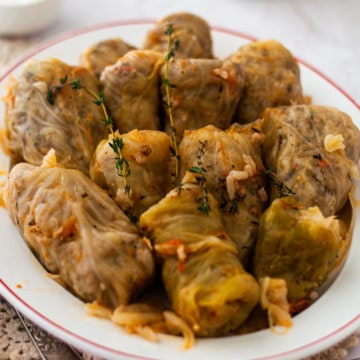
Vegetarian Stuffed Cabbage Rolls
This vegetarian stuffed cabbage features tender cabbage leaves wrapped around a savory mixture of mushrooms, seasoned soy “meat,” rice, and aromatics. Slow-baked in a rich tomato sauce, these rolls are a comforting, nutrient-packed main dish perfect for family dinners or special occasions.
Equipment
- Large stockpot (for blanching cabbage)
- Large skillet or sauté pan
- Mixing bowls
- Sharp knife & cutting board
- Wooden spoon
- Cast Iron with the lid or heavy-bottomed pot
- Measuring cups & spoons
Ingredients
Cabbage and Filling
- salt to taste
- 2 tablespoon vinegar
- 2 ¼ lb large head of green cabbage (1.2kg)
- 3 tablespoon vegetable oil
- 10 ⅝ oz yellow onion finely diced (300g)
- 2.2 oz green bell pepper diced (60g)
- 2 ½ oz carrot (70g)
- ⅓ oz parsley finely chopped (10g)
- 1 tablespoon bouillon powder
- ½ teaspoon salt
- ½ teaspoon black pepper
- 3 eggs
- 8 oz mushrooms finely chopped (with a food mixer) (227 g)
- 4.5 oz textured vegetable protein (soy “meat”) (125g)
- 1 tablespoon paprika powder
- 3 tablespoon nutritional yeast
- 1.2 lb uncooked long-grain rice (540g)
For the Sauce
- cabbage ribs and half of the leftovers
- 4 teaspoon fresh thyme on the bottom or 1.5 teaspoon dried thyme
- 4 teaspoon fresh dill on the bottom or 1.5 teaspoon dried dill
- 3 bay leaves on the bottom
- all the leftover cabbage leaves
- 4 teaspoon fresh thyme on the top or 1.5 teaspoon dired thyme
- 4 teaspoon fresh dill on the top, finely chopped or 1.5 teaspoon dried thyme
- 3 bay leaves on the top
- 1 cup tomato sauce or tomato juice (or crushed tomatoes)
- 4 tablespoon vegetable oil
- 16 cups water (4L) or until it covers the cabbage rolls
Instructions
Prepare Cabbage Leaves
- Bring a large pot of water to a boil. Add the vinegar and salt in the water. Salted water helps season the cabbage, and the vinegar can help soften the fibrous structure slightly, making the leaves more pliable and easier to roll without tearing.salt to taste, 2 tbsp vinegar
- Core the cabbage and carefully lower it into boiling water.2 ¼ lb large head of green cabbage
- Blanch the cabbage for 5–8 minutes until the outer leaves are soft and pliable. Then remove them one by one. Let them cool enough to handle.
- Identify the thick central vein (rib) running down the middle of each leaf. Use a small, sharp knife or paring knife to cut out — removing the toughest part makes the leaf much easier to roll without tearing. If the leave is smaller, just shave down this thick rib so it can be easier to work with.
- If a leaf is too large or too wide, simply cut it into two smaller pieces. Make the cut roughly along a natural seam or parallel to the removed rib so each piece stays roughly rectangular and easy to roll.
Make the Filling
- Heat vegetable oil in a large skillet over medium heat. Add the diced onions and bell peppers and sauté until translucent (about 4–5 minutes).3 tbsp vegetable oil, 10 ⅝ oz yellow onion, 2.2 oz green bell pepper
- Add the shredded carrot and the finely chopped parsley, and sauté for 3 more minutes.2 ½ oz carrot, ⅓ oz parsley
- Add the bouillon powder, salt, and black pepper. Cook for 1 minute.1 tbsp bouillon powder, ½ tsp salt, ½ tsp black pepper
- Add mushrooms and stir in rehydrated soy meat (or plant-based meat), then cook for 8 minutes, or until the mushrooms liquid evaporates.8 oz mushrooms, 4.5 oz textured vegetable protein (soy “meat”)
- Remove the skillet from the heat, stir in the paprika and nutritional yeast, then mix in the beaten eggs until fully combined.1 tbsp paprika powder, 3 tbsp nutritional yeast, 3 eggs
- Add rice and mix well. Taste and adjust the seasoning as needed.1.2 lb uncooked long-grain rice
Assemble Rolls
- Lay one cabbage leaf flat, and place 1-2 tablespoons of filling near the base.
- Fold the firmer side of the cabbage leaf over the filling so that it fully covers it, then roll the leaf up firmly, enclosing the filling like a neat bundle.
- Hold the cabbage roll snugly and press the top edge of the leaf inward to seal the filling securely before setting it seam-side down.
How to Cook the Cabbage Rolls
- In a large Dutch oven, arrange your cabbage ribs and half of the leftover trimmed cabbage pieces in an even layer on the bottom. These act as a natural trivet so the cabbage rolls don’t stick and help infuse flavor into the cooking liquid.cabbage ribs and half of the leftovers
- Scatter fresh herbs over the cabbage base — such as thyme, dill, and bay leaves. These aromatics will perfume the sauce and rolls as they cook.4 tsp fresh thyme on the bottom, 4 tsp fresh dill on the bottom, 3 bay leaves
- Place your assembled stuffed cabbage rolls seam-side down on top of this cabbage and herb base in one layer (or two layers). Try to nestle them snugly so they support each other while cooking.
- Chop all the leftover cabbage leaves into small pieces, similar in size to sauerkraut, and spread them over the cabbage rolls. This enriches the overall flavor of the dish.all the leftover cabbage leaves
- Pour the tomato sauce (or tomato juice or crushed tomatoes) evenly over the layered cabbage rolls. Make sure most of the rolls are covered, but avoid displacing them; the sauce will help steam and braise them into tenderness.1 cup tomato sauce or tomato juice
- Sprinkle another small pinch of dill, thyme, and additional bay leaves over the sauce for extra aromatic flavor as it simmers.4 tsp fresh thyme on the top, 4 tsp fresh dill on the top, finely chopped, 3 bay leaves on the top
- Drizzle a bit of vegetable oil over everything — this helps carry the flavors and keep the liquid from foaming while simmering.4 tbsp vegetable oil
- Pour in enough water to almost reach the top of the rolls — you want a good amount of braising liquid but not so much that the sauce becomes too thin.16 cups water
- Cover the pot, bring the liquid up to a full boil over high heat, then reduce the heat to low so it gently simmers. Let it simmer, covered, for about 45 minutes or until the cabbage is tender and the flavors are melded.
- Avoid boiling violently; a gentle simmer lets the flavors meld, and the rolls stay intact.
- Once the cabbage rolls are fully cooked, turn off the heat and leave the pot covered. Avoid handling the rolls at this stage, as they are delicate and can break easily.
- Let them rest undisturbed for at least 2 hours before serving. This resting time lets the juices redistribute and the rolls firm up, making them easier to serve and more flavorful.
Serve
- Serve the cabbage rolls warm, with a generous dollop of sour cream and slices of crusty sourdough bread on the side — then enjoy.
Notes
- Soy Meat Tips: If using dry textured vegetable protein (TVP), rehydrate in hot vegetable broth for a deeper flavor before sautéing. Alternatively, use a pre-seasoned plant-based ground meat substitute.
- Mushrooms are a great source of umami flavor that deeply enriches vegetarian fillings — they give your rolls a satisfying “meaty” taste without meat.
-
Layering & Cooking Tips
- When arranging rolls in the pot, nestle them snugly so they support each other — this helps them keep shape while cooking and prevents them from opening.
- Using extra cabbage ribs or leftover leaves as a base layer under the rolls not only adds flavor but also prevents scorching on the bottom. This traditional technique also adds a bit of natural sweetness as the ribs slowly braise with the sauce.
- Always taste your filling before rolling — especially if you’re using uncooked rice — and adjust the seasoning because the rice will absorb salt and spices as it cooks.
- Egg in the filling (beaten and mixed in) improves structure and moisture, helping the rolls stay together during braising without becoming dry.
-
Cabbage Handling
- Make sure to trim (or cut) the thick ribs of each cabbage leaf before rolling — this makes folding and rolling easier and prevents tearing.
- If some leaves are very large, cut them in half and overlap them as you roll to maintain a neat bundle that isn’t unwieldy.
- Letting the rolls rest covered off the heat for at least 2 hours improves texture and flavor blending — the sauce continues to infuse the rolls even after cooking is done.
-
Leftovers
- Cool completely first: Let leftover cabbage rolls cool to room temperature before storing — this helps prevent condensation inside the container, which can make them soggy.
- Store with sauce: Place the rolls and their sauce in an airtight container or cover the original pot tightly. This keeps the rolls moist and flavorful.
- Use within a few days: Properly stored, leftover cabbage rolls will keep well in the refrigerator for about 3–4 days.
-
Freeze
- Freeze cooked rolls: Lay cooled rolls in a single layer and freeze until solid, then transfer to freezer‑safe bags or containers. Add sauce on top to prevent freezer burn. Frozen cabbage rolls can be kept up to 3 months for the best quality.
- Thaw before reheating: For best results, thaw frozen cabbage rolls overnight in the fridge before reheating.
Nutrition
Calories: 122kcalCarbohydrates: 19gProtein: 3gFat: 4gSaturated Fat: 1gCholesterol: 16mgSodium: 140mgPotassium: 185mgFiber: 2gSugar: 2gVitamin A: 528IUVitamin C: 16mgCalcium: 31mgIron: 1mg
Tried this recipe?Let us know how it was!
